
A notes app works fine when all you need is a few lines after therapy. But if you also want to record the conversation, revisit a session summary or spot patterns across several months, there are tools designed for that exact workflow.
We compared four options using the same questions: Can it record sessions? Can you keep notes between them? Does it connect what happened over time? Can you involve your therapist? What is genuinely free, and what will regular use cost? Disclosure: Freud Magazine is published by the team behind Freud, the first app below.
Four apps, four different approaches
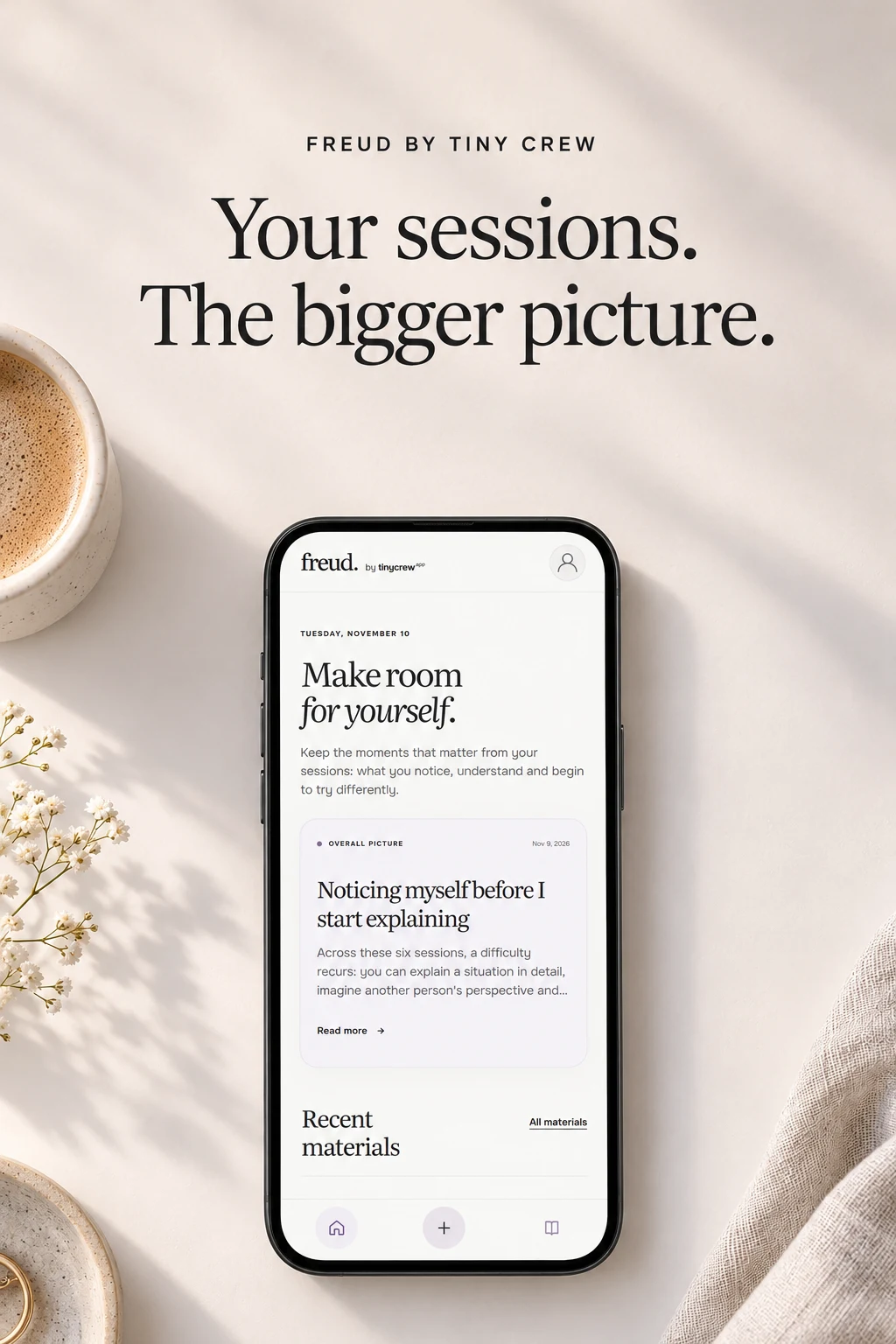 Promotional composition based on the Freud app interface
Freud
A therapy-session organiser: record a conversation with consent, turn it into a transcript and a detailed AI summary, and keep personal notes between appointments. Overall Picture draws on sessions and written materials to track recurring themes. You can grant your own therapist access to selected materials.
Pros
- Session recording, transcription and a structured AI summary of the conversation.
- Overall Picture connects session analyses and personal notes across time.
- Notes and recording are free; a new user can try the analysis. Pay only when needed, with no subscription.
- Granular access for your own therapist; personal materials are encrypted.
Cons
- Transcription and AI analysis use paid credits after the trial allowance.
- Original session audio is kept for 24 hours rather than as a permanent recording archive.
Free notes and recording. A new account gets a trial AI analysis and Overall Picture update. After that, around €2 to analyse a one-hour session, depending on the credits pack; no subscription.
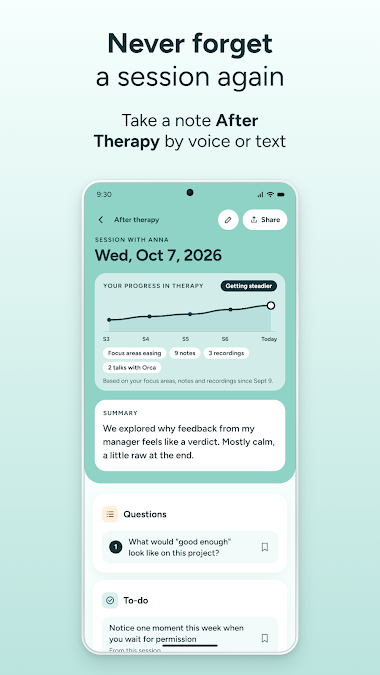 MindSync / Google Play screenshot
MindSync
MindSync is built around preparing for therapy and staying engaged between visits. It records and summarises sessions, makes before-and-after cards, supports notes and mood check-ins, and offers an AI companion called Jake. It also produces weekly and monthly recaps.
Pros
- Session recording, transcripts and brief summaries with questions and to-dos.
- Before/after cards, voice and text notes, plus an agenda for the next session.
- Mood and goal tracking, AI companion Jake and periodic progress summaries.
- iOS and Android apps; export a summary card to share with your therapist.
Cons
- Free plan permits only two recordings in total and three between-session notes per month.
- Unlimited routine use requires a subscription; sharing involves sending a saved card yourself.
Free tier with limits; Premium $14.99/month or $144.99/year (US website prices).
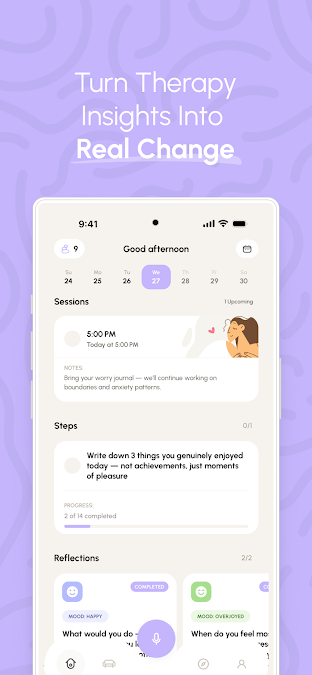 Relvema / Google Play screenshot
Relvema
Relvema records therapy sessions and turns them into summaries, then brings key points back before the next appointment. Between visits it offers journal prompts, reminders and small action steps; a progress timeline pulls these entries into one view.
Pros
- Session recording with a transcript, key moments and a concise summary.
- A quick recap ahead of the next appointment.
- Prompts for between-session reflection, reminders and a progress timeline.
- Can link with your therapist; two hours of recording to try for free.
Cons
- Unlimited recording and full history are reserved for Plus.
- Regular use requires a subscription; there is no stated pay-per-session option.
First two hours of recording free; Plus $12.99/month or $89.99/year (US website prices).
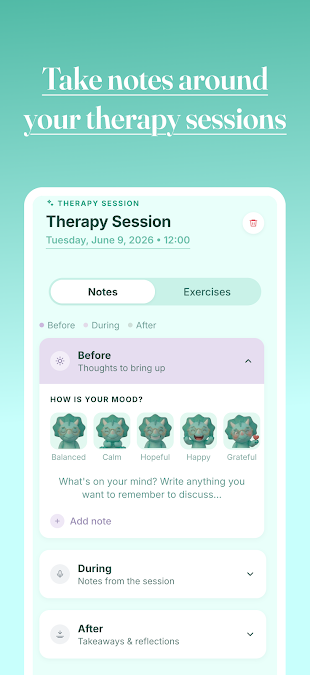 TheryMate / Google Play screenshot
TheryMate
TheryMate is a private therapy journal rather than a recording tool. It organises session notes, mood check-ins, a calendar and exercises around thought patterns and beliefs. Personal content is encrypted on the device; optional backup is end-to-end encrypted.
Pros
- Free session notes, calendar and mood check-ins.
- Exercises for beliefs and between-session tasks.
- Local encryption and device unlock; end-to-end encrypted optional backup.
- A lifetime Plus purchase is available instead of a recurring subscription.
Cons
- No session recording with automatic transcription or audio-based summaries.
- No integrated AI Overview based on all session materials; you connect the notes yourself.
Session notes, calendar and mood tracking free; Plus by subscription or a one-time lifetime purchase, with a 14-day trial.
Which one is right for you?
Want a simple, private therapy journal and mood tracker, with no need to record conversations? Start with TheryMate. Need guided reflection and frequent check-ins between appointments? MindSync has more of those tools; Relvema focuses on reminders, recaps and a therapy timeline.
If your priority is keeping the sessions themselves, extracting a detailed summary and maintaining an Overall Picture without paying for idle months, Freud has the most direct pricing model: free notes, then credits for the AI work you choose to run.
Features and advertised prices checked on 10 November 2026. Local app-store pricing, plan availability and free limits may differ by country.